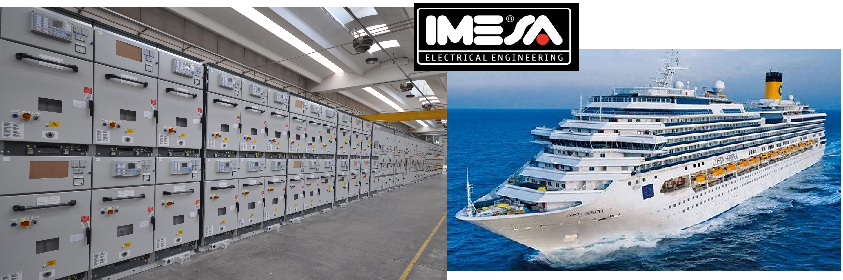

Sailing on a modern cruise ship means moving on what is essentially a floating power plant. The power levels involved are enormous, yet the available space in the engine rooms remains a luxury that designers cannot afford. At IMESA, we face this contradiction every day: how to fit tens of megawatts of power into increasingly constrained volumes, while leaving more space for passenger areas.
The answer does not lie only in making components smaller, but in rethinking the very architecture of electrical distribution systems. When we talk about high-power-density electrical switchgears for the cruise sector, the real challenge is managing heat and safety without increasing the physical footprint of the switchgear.
Thermal management beyond standard limits
In an engine room where ambient temperature is already high, an electrical switchgear handling very large rated currents generates a significant amount of heat that cannot be overlooked. While onshore industrial installations can rely on natural ventilation or wide maintenance corridors, on board a ship every centimeter counts.
For this reason, IMESA engineering focuses on intelligent forced-ventilation systems and the use of materials that optimize heat dissipation. It is not just about installing fans, but about designing internal airflow paths to avoid hot spots that could compromise power electronics or protection systems. A compact switchgear that overheats is a risk no shipowner can accept.
Safety and resistance to mechanical stress
A cruise ship is not a static environment. It is subject to constant vibrations, rolling, pitching, and in worst cases, mechanical stress caused by emergency maneuvers or severe weather conditions. Designing a high-density switchgear means ensuring that all internal connections, from copper busbars to auxiliary wiring, remain resistant to these stresses without loosening over time.
Arc fault containment is another fundamental pillar. In such confined spaces, an internal fault must be instantly contained to prevent it from propagating to adjacent sections, jeopardizing the vessel’s operational continuity. Our solutions are tested to ensure that, even in the event of an internal catastrophic failure, energy is safely directed upward or into designated safe zones, protecting technical personnel.
Integration of automation systems
Today, we no longer ship simple circuit breakers to sea. IMESA electrical switchgear for the marine sector are nodes in a complex network that continuously communicates with the ship’s Energy Management System (EMS). This digital integration allows us to reduce bulky physical wiring in favor of field buses and high-speed communication protocols.
Fewer cables mean more space, but also much more precise diagnostics. On-board engineers can monitor the health status of each individual breaker from a remote console, anticipating maintenance needs before they become operational issues during navigation. It is this synergy between electrical power and digital intelligence that defines modern marine engineering.
Towards the future of electric propulsion
With the rise of hybrid propulsion systems and the increasing use of onboard battery storage, the complexity of power distribution swtichgears is set to grow further. At IMESA, we are already working on the next generation of distribution systems integrating frequency converters and energy storage systems, while remaining true to our mission: delivering maximum power in minimum space, without ever compromising the safety and reliability that the maritime environment demands.
Toward the Future of Electric Propulsion
With the advent of hybrid propulsion systems and the widespread use of onboard batteries, the complexity of distribution switchgears is set to increase even further. At IMESA, we are already working on the next generation of distribution systems integrating frequency converters and energy storage systems, while remaining fully committed to our mission: delivering maximum power in the smallest possible space, without ever compromising the safety and reliability that the sea demands.