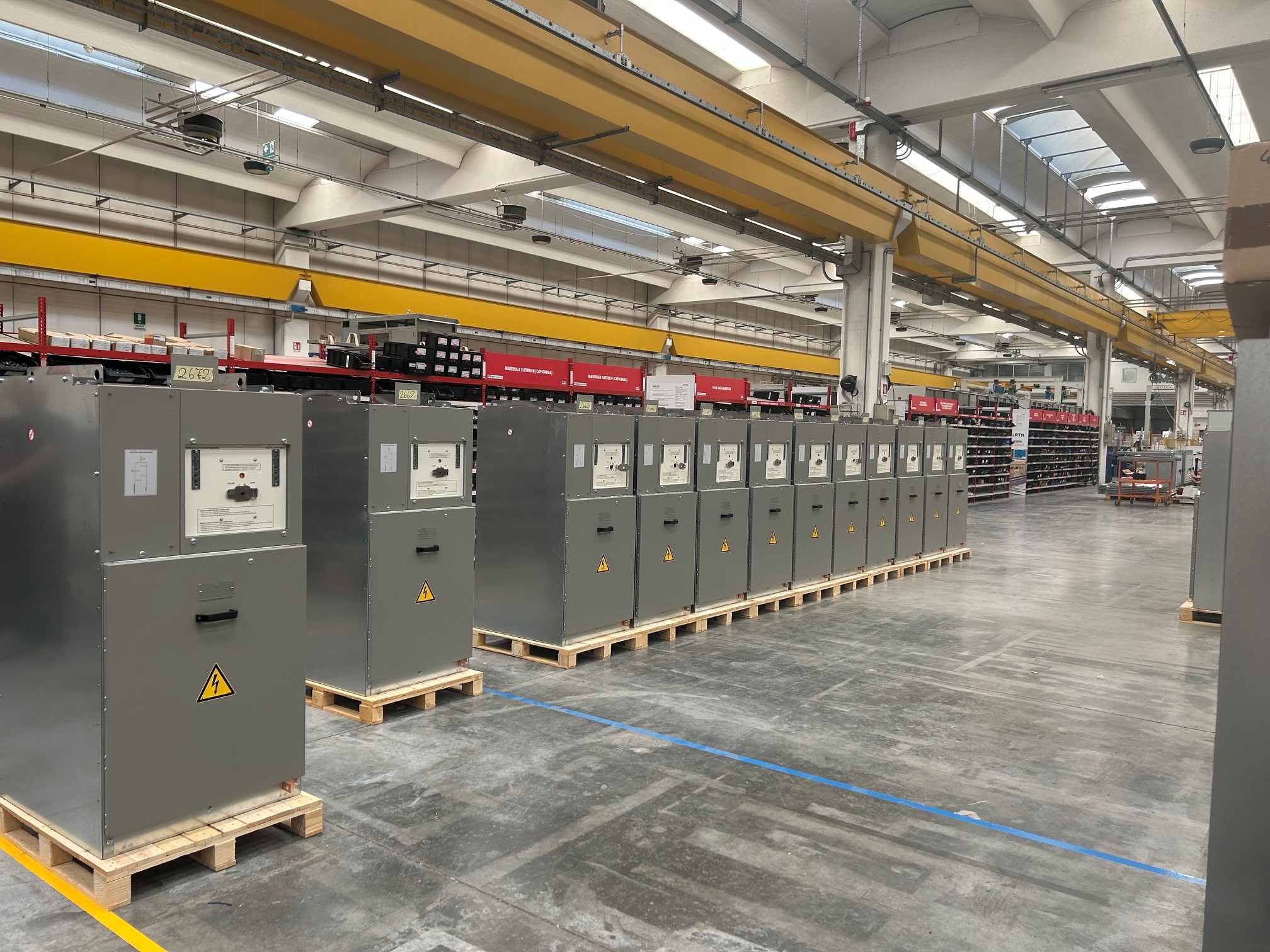

When designing a complex electrical infrastructure, the distinction between primary and secondary distribution is not a theoretical detail. It is one of the steps that most impacts reliability, protection selectivity, service continuity, and load management. This applies to industrial plants, data centers, naval installations, and any context where energy must not only reach its destination, but do so with stability, coordination, and control. This difference is often simplified as a question of power or voltage level. In reality, the point is broader. Primary and secondary distribution perform different functions within the electrical architecture and respond to different design priorities. The former governs the reception and distribution of energy to large plant areas. The latter distributes power extensively to machines, utilities, and services, following a logic closer to the actual behavior of loads. Understanding how these two levels relate is also essential when drafting specifications, coordinating protection systems, or choosing the structure of electrical panels. This is where the electrical hierarchy stops being a schematic and becomes a design choice.
What is primary distribution?
Primary distribution is the upstream level of the low-voltage electrical system. It is where energy from the medium-voltage, transformers, or local generation systems is received, organized, and sent to the main system backbones. This level typically includes Power Centers, i.e., the switchboards that concentrate high currents and are responsible for powering entire departments, subsystems, or secondary switchboards. They are central nodes of the infrastructure and therefore must be designed with particular attention to mechanical robustness, short-circuit resistance, heat dissipation, and service continuity. Primary distribution has more than just a distribution function. It also has a management function. This is where the general logic of outgoing feeders, reserves, connections between sections, and the system’s behavior in the event of an anomaly or maintenance is established. For this reason, primary switchboards cannot be thought of as simple energy transfer points. They are the level at which the balance between power availability, protection, and selectivity is defined.
The Role of Power Centers in Electrical Architecture
When it comes to primary distribution, the primary point of reference is the Power Center. This is a low-voltage electrical panel designed to handle very high nominal currents, often exceeding 4000 A, and short-circuit levels that require a particularly robust internal structure. The Power Center is the panel that supplies the main lines of the system. The most important utilities or connections to secondary distribution panels originate from here. Its function is therefore strategic, because a problem at this level can quickly spread to entire production areas or essential services. From a design perspective, the size of the busbars, electrodynamic resistance, thermal insulation, internal compartmentalization, and the choice of circuit breakers are key factors in a Power Center. In many cases, air circuit breakers, or ACBs, are used, with advanced protection units that allow for precise adjustment of tripping times and thresholds. This distribution level must be configured to properly withstand downstream events without inappropriate intervention. If a fault occurs on a secondary line, the Power Center should not be the first element to trip. Its role is to ensure that the protections closest to the fault point intervene, preserving the continuity of the rest of the system.
This distribution level must be configured to properly withstand downstream events without inappropriate intervention. If a fault occurs on a secondary line, the Power Center should not be the first element to trip. Its role is to ensure that the protections closest to the fault point intervene, preserving the continuity of the rest of the system.
What is secondary distribution?
Secondary distribution is the level that delivers electrical power from the main switchboards to the final loads or groups of local loads. At this stage, the electrical network comes closer to the actual process, supplying production lines, auxiliary systems, lighting, building services, and individual machines. Unlike primary distribution, which serves as the system backbone, secondary distribution operates through a more localized approach.
Current levels are generally lower, but the number of outgoing feeders increases, the variety of loads becomes greater, and the ability to isolate faults quickly and selectively becomes increasingly important. Secondary distribution boards must therefore provide local protection, operational flexibility, and ease of management. This is the level where the quality of the electrical coordination within the installation becomes most evident, since any fault affecting a single load should remain confined without impacting the other circuits supplied by the same system.
Secondary Distribution Boards, Local Protection, and Operational Flexibility
In secondary distribution boards, the priority is not the concentration of maximum power but the ability to manage multiple feeders and diverse loads effectively. This level commonly employs molded-case circuit breakers (MCCBs) or miniature circuit breakers (MCBs), selected and coordinated according to the characteristics of each load and the expected behavior under fault conditions. The key objective is local protection. If a motor, service line, or machine experiences a fault, the system should isolate only that specific branch, preventing the disturbance from propagating to other loads. This approach is particularly important in industrial facilities, where the shutdown of a single load may be manageable, whereas losing power to an entire section of the plant can have significant consequences for production. Secondary distribution is also the level where more detailed energy monitoring is typically implemented. Power analyzers, energy monitoring devices, and communication systems are often installed here because they provide accurate information about individual feeders, enabling a much more detailed understanding of plant performance.
The Difference Between Primary and Secondary Distribution
The difference between primary and secondary distribution is not simply related to switchboard size or rated current. The real distinction lies in the function each level performs within the electrical system.
Primary distribution receives, concentrates, and distributes power to the main plant feeders. It operates with higher current levels, manages the overall power distribution strategy, and ensures the selectivity required to protect the entire electrical architecture. Secondary distribution, on the other hand, takes that power and delivers it to the final loads, providing greater detail in protection and load control. Simply put, primary distribution governs the overall structure of the electrical system, while secondary distribution manages its local distribution. The first must guarantee robustness and a comprehensive system view. The second must ensure precision, fault isolation, and adaptability to actual operating loads. This distinction plays a crucial role in determining the overall quality of an electrical installation. If the hierarchy between the two levels is not clearly defined, the risks of non-selective tripping, unnecessary oversizing, maintenance difficulties, and reduced system clarity all increase.
Selectivity and Coordination Between the Two Distribution Levels
One of the most critical aspects of industrial electrical system design is the coordination between primary and secondary distribution. It is not enough for individual switchboards to be well designed. They must work together according to a consistent protection hierarchy. Protection selectivity exists precisely for this purpose. In the event of a fault, the protective device closest to the fault location should operate first, while all unaffected circuits remain energized. Although this principle appears straightforward, achieving it requires careful selection of circuit breakers, trip curves, operating thresholds, timing, and coordination strategies. At the primary level, protection must be sufficiently robust to withstand transient conditions while allowing downstream protective devices to respond first. At the secondary level, protection must operate rapidly and selectively to isolate faults without causing unnecessary outages elsewhere. When this balance is achieved, the system benefits from greater service continuity, improved reliability, and easier technical management. Conversely, poor coordination can allow even a localized fault to escalate into a widespread power interruption.
Monitoring, Communication, and Digital Integration
Today, the distinction between primary and secondary distribution also concerns the way electrical data is collected and managed. In a modern infrastructure, switchboards are no longer just distribution devices. They are information nodes that contribute to energy monitoring, diagnostics, and system supervision.
At the primary level, data is primarily used to monitor the overall balance of the system, energy quality, main loads, and power continuity. At the secondary level, however, measurements can be more detailed and help understand the behavior of individual lines, departments, or the most critical utilities.
Integration via industrial communication protocols allows these two levels to be connected to SCADA systems, BMSs, or energy management platforms. In this way, the electrical hierarchy also translates into an information hierarchy, useful for both routine management and maintenance, energy audits, and efficiency strategies.
Why Primary and Secondary Distribution Should Be Designed as One Integrated System
One of the most common mistakes is to treat primary and secondary distribution as two separate worlds. In reality, system performance depends on the coherence with which the two levels are designed together. A well-sized Power Center, yet disconnected from the actual logic of downstream distribution, is not enough. Likewise, a highly complex secondary distribution system lacking proper coordination with the main switchboard risks losing effectiveness precisely at critical moments. The architecture works when there is continuity between the robustness of the backbone, the precision of local distribution, and the quality of coordination between protection, measurement, and control.
For this reason, in the most robust projects, the value lies not in the single switchboard taken in isolation, but in the ability to build a coherent solution from the primary level to the final distribution. It is this systemic vision that allows for reducing incompatibilities, simplifying maintenance, improving service continuity, and making the entire system more understandable.