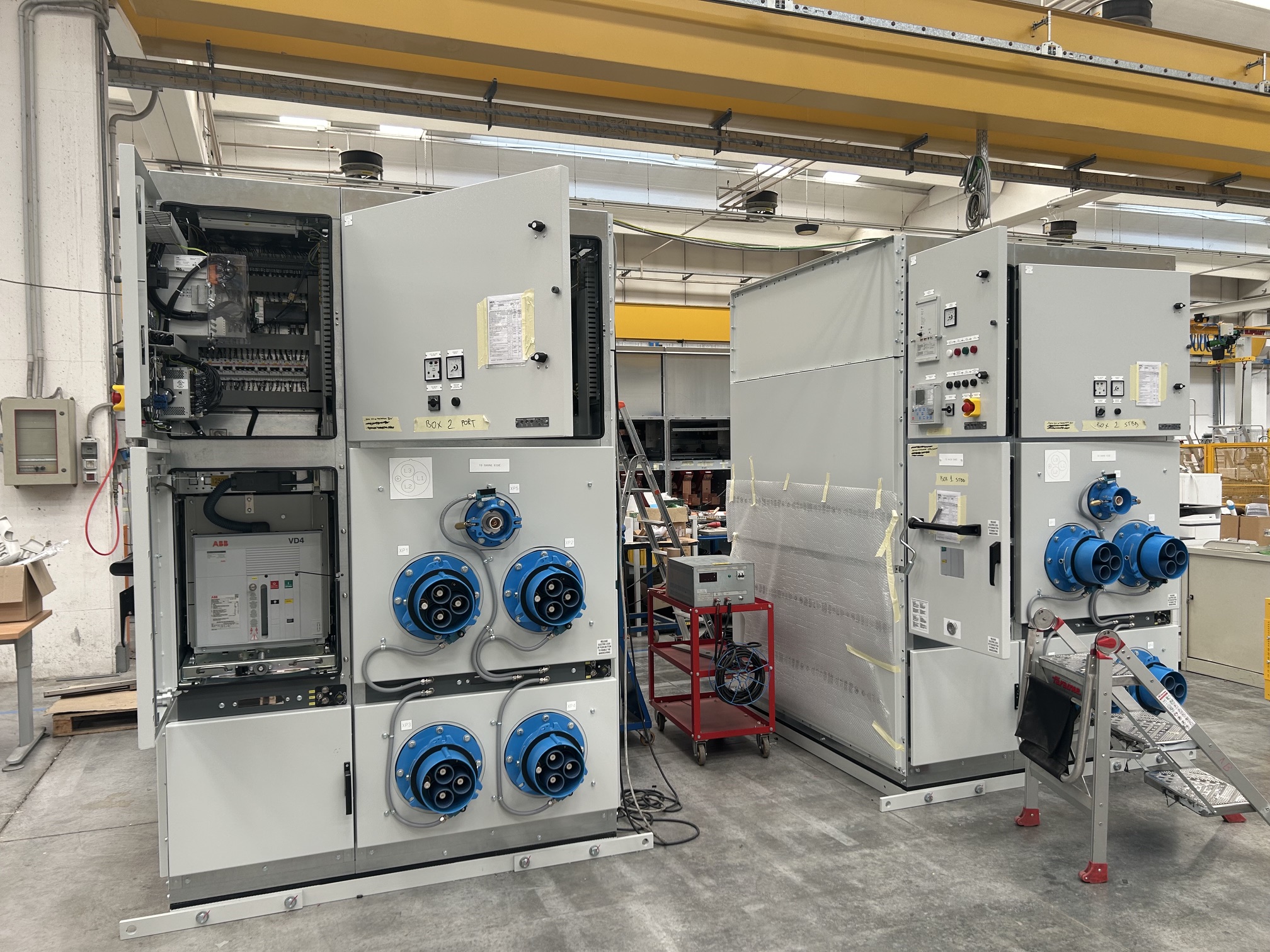

Cold ironing, also known as Onshore Power Supply (OPS) or shore power, is one of the most effective technologies for reducing emissions generated by vessels while they are berthed. By allowing ships to shut down their auxiliary engines and connect directly to the onshore electrical grid, OPS systems significantly reduce local emissions while improving air quality in port areas. Behind this apparently simple concept lies a highly engineered electrical solution. A reliable shore power installation requires an integrated electrical power infrastructure including medium-voltage switchgear (MV switchgear), Static Frequency Converters (SFCs), protection systems, synchronisation controls, automation functions and advanced monitoring technologies. All these elements must operate together to ensure safe, stable and seamless power transfer between the port electrical network and the vessel’s shipboard electrical system.
For the maritime industry, cold ironing is no longer only an environmental measure. It has become a strategic component of port decarbonisation strategies, supporting regulatory compliance, improving operational efficiency and enabling ports to meet increasingly demanding sustainability targets. As European regulations accelerate the deployment of shore power facilities in major ports, electrical infrastructure has become a key enabler of the maritime energy transition. The success of an OPS project depends on the ability of the electrical system to guarantee power quality, system availability and operational safety in a complex environment where reliability is essential. At IMESA, we design and manufacture medium-voltage switchgear and power distribution systems for critical applications where high power levels, marine-grade construction and continuous operation are fundamental requirements. Our solutions are engineered to support the evolving needs of modern ports, combining electrical performance, protection, automation and digital capabilities within a single reliable infrastructure.
What Is Cold Ironing and Why Is It Important for Ports?
Cold ironing, commonly referred to as Onshore Power Supply (OPS) or shore-to-ship power, allows vessels to receive electricity directly from the shore grid while berthed, eliminating the need to operate onboard auxiliary generators during port stays. This approach significantly reduces emissions of carbon dioxide (CO₂), nitrogen oxides (NOₓ), sulphur oxides (SOₓ) and particulate matter (PM) in port areas—locations where environmental impacts directly affect port workers, nearby communities and urban environments. The importance of OPS is continuously increasing as ports become central elements of global energy transition strategies. Today, the competitiveness of a port is no longer measured only by its logistics capacity, but also by its ability to provide sustainable energy services, reduce environmental impact and integrate into a broader vision of green and sustainable port infrastructure. In this context, berth electrification is not simply a technological improvement. It represents a structural transformation of port energy systems, creating the foundation for cleaner, more efficient and future-ready maritime operations. Modern ports are evolving from traditional logistics hubs into integrated energy ecosystems where electrification, digitalisation and sustainability converge. Within this transformation, shore power infrastructure plays a key role by enabling vessels to reduce emissions while maintaining operational efficiency.
How Onshore Power Supply Works: The Technical Perspective
From a technical standpoint, an Onshore Power Supply (OPS) system requires accurate management of the power transfer between the port’s electrical infrastructure and the vessel’s shipboard electrical system.
The objective is not simply to provide electrical power to a berthed vessel, but to establish a stable, secure and fully compatible connection capable of operating under demanding conditions while maintaining high levels of reliability and safety.
A complete shore power installation involves several interconnected subsystems, including medium-voltage distribution equipment, power conversion systems, protection and control devices, communication interfaces and automated synchronisation functions. Each component plays a critical role in ensuring that electrical energy is transferred efficiently and without disruption.
The Role of Electrical Switchgear in Cold Ironing
In cold ironing systems, electrical switchgear forms the operational core of the entire infrastructure. It must manage high power levels, coordinate protection systems, communicate with control systems, and ensure dependable operation even under severe environmental conditions. Port installations are constantly exposed to salt spray, humidity, and corrosive agents, requiring considerably more stringent design standards than many land-based industrial applications.
For this reason, engineering design must consider not only electrical performance but also mechanical durability and enclosure protection. Marine-grade metal structures, internal compartmentalization, mechanical and electrical interlocking systems, and coordinated protection devices are all essential elements for minimizing failure risks and ensuring safe connection and disconnection procedures.
In cold ironing, safety cannot be separated from service continuity—the two are intrinsically linked. An infrastructure that cannot effectively control arc flash risks, maintain connection stability, and guarantee selective protection is unsuitable for an operational environment where equipment failures or power interruptions can have immediate consequences for both ships and port operations.
Cold Ironing, Technical Standards, and the European Regulatory Framework
The widespread adoption of cold ironing is supported by an increasingly well-defined regulatory framework. From a technical perspective, shore power systems are governed by international standards, most notably the IEC/IEEE 80005 series, which establishes the key technical requirements for shore-to-ship electrical connections. These standards are fundamental because they define how a reliable interface between port infrastructure and onboard electrical systems should be designed and operated. From a regulatory standpoint, Europe is also accelerating adoption. The Alternative Fuels Infrastructure Regulation (AFIR) strengthens the objective of developing alternative energy infrastructure across the transport sector, including the electrification of berths in major maritime ports. As a result, cold ironing is no longer simply an advanced technological option—it is becoming an integral part of infrastructure modernization strategies across European ports. For port authorities, terminal operators, and shipowners, the implications are clear. Investing in cold ironing systems means anticipating increasingly stringent environmental standards, improving operational performance, and preparing for a future in which energy, digitalization, and sustainability converge within the modern port ecosystem.
The Environmental Benefits of Cold Ironing for Ports and Urban Areas
The most immediate advantage of cold ironing is the reduction of emissions while ships are in port. When vessels switch off their auxiliary engines during berthing, local emissions associated with onboard power generation are dramatically reduced. This has a direct and measurable impact on air quality in port areas and neighboring urban environments, where maritime traffic and logistics activities often contribute significantly to pollution. There is also another important, though sometimes overlooked, benefit. Cold ironing substantially reduces the noise and vibrations generated by continuously operating auxiliary engines, improving working conditions within ports while minimizing disturbances for nearby communities. For this reason, berth electrification is increasingly recognized as a practical and effective tool for environmental sustainability—not only for the port itself but for the wider territory surrounding it.
Energy Monitoring and the Digitalization of Shore-to-Ship Systems
An effective cold ironing infrastructure does more than deliver electricity. It must also measure, monitor, and analyze energy usage. For this reason, advanced electrical switchgear integrates intelligent metering systems and communication protocols that enable real-time monitoring of electrical parameters and energy consumption. Digitalization provides clear operational value. It allows operators to analyze delivered energy, verify service quality, detect anomalies, and build reliable datasets for both technical management and economic optimization of the infrastructure. For ports seeking greater efficiency and sustainability, access to accurate energy data is no longer an added feature—it is an essential function. Within this framework, electrical switchgear evolves from a simple power distribution device into a strategic asset for the entire port. Its ability to combine protection, operational continuity, diagnostics, and digital communication has a direct impact on project quality and on the long-term industrial reliability of cold ironing installations.
Cold Ironing as a Key Infrastructure for Port Decarbonization
Talking about cold ironing means talking about the future of energy in ports. The decarbonisation of the maritime sector also depends on the ability to develop infrastructures that enable the effective electrification of vessels during their time at berth. Providing connection points alone is not enough. Ports require an electrical power infrastructure designed to operate continuously, safely and reliably, with the flexibility needed to adapt to different vessel profiles and the technical constraints of the port environment. This is why cold ironing plays a strategic role. It is a technology that brings together energy transition, improved air quality, advanced electrical engineering and regulatory compliance. Above all, it is a technology that requires genuine engineering expertise, because every project integrates medium-voltage distribution, frequency conversion, protection systems, automation and resistance to harsh environmental conditions into a single operational ecosystem.
For IMESA, this means designing electrical infrastructures that go beyond fulfilling a specific function. Our solutions are developed to deliver long-term reliability, operational safety and a clear industrial vision for the future of sustainable port infrastructure.