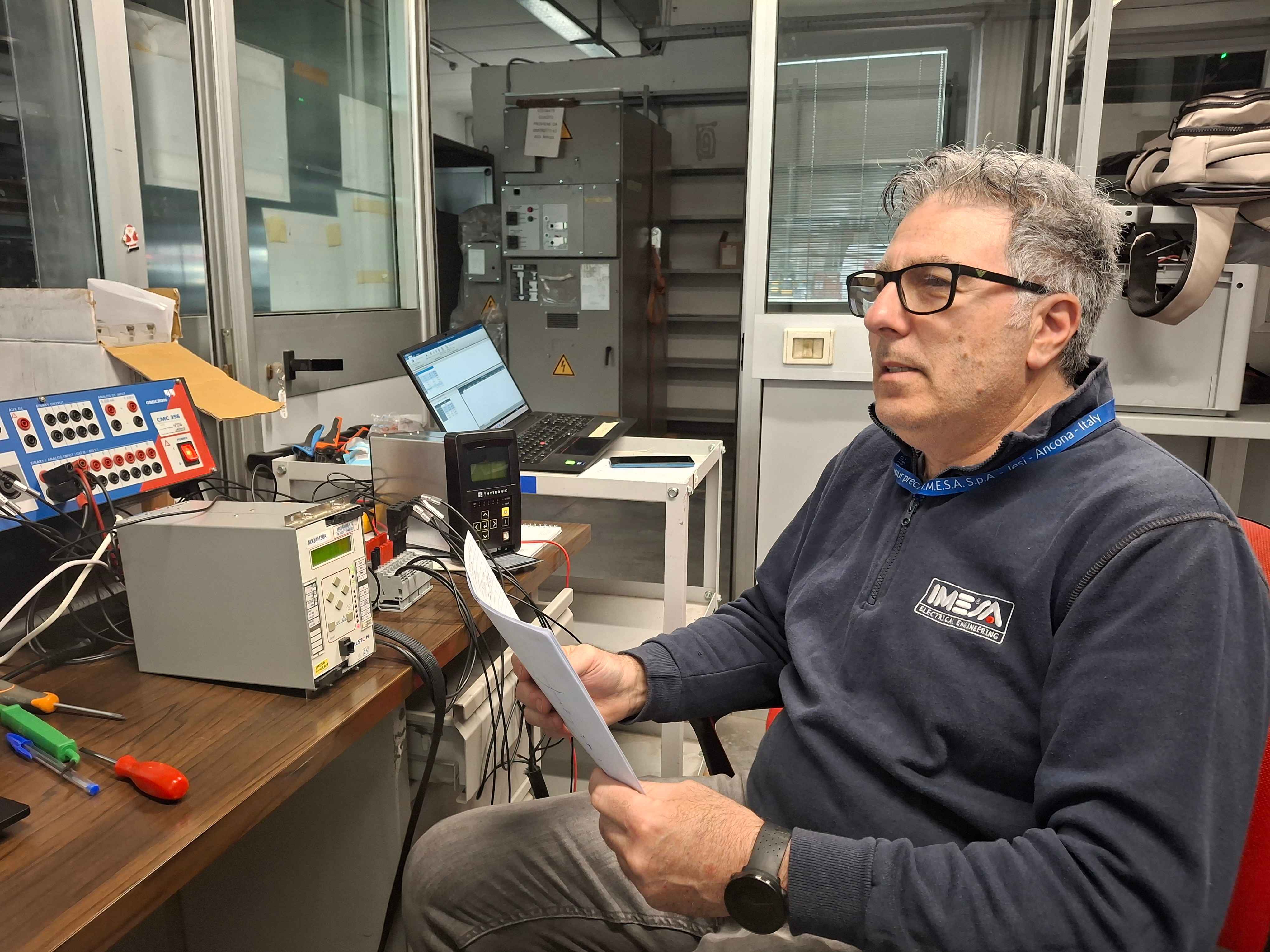

With more than 38 years of experience at the company, Fabio Ferlito represents a concrete example of growth built through hands-on experience. From metalworking to Field Service, his journey tells the story not only of the evolution of a profession, but also of a mindset: curiosity, an observant attitude, and the ability to always look “beyond” the individual component.
Michela: Hi Fabio, today you are a Field Service Engineer, but you have a long professional journey behind you. Could you tell us which experiences shaped you the most and how they led you to where you are today?
Fabio: I started working at a very young age, doing seasonal jobs while studying to become an electromechanical technician. I have been with Imesa for 38 years. At the beginning, I joined the metalworking department, but training in the 1980s was very different from today: you were expected to do a bit of everything. It was precisely this all-round experience that later allowed me to build a complete set of skills.
I like to say that I belong to the generation that followed the entire process: we built the control panel in the workshop and then went directly to the customer’s site to install and commission it. Being involved in every stage of the project taught me not only the technical aspects of the job, but also the value of responsibility, attention to detail, and the ability to adapt to different situations in the field.
It was an experience that deeply shaped me, both professionally and personally, and one that still influences my approach to Field Service today.
Michela: Was there a particular moment or project that made you realize the world of service was the right fit for you?
Fabio: Definitely an important project in the naval sector, which I followed for about three years as Imesa’s point of reference. It was a very formative experience because it allowed me to work continuously on every phase of the project, from workshop activities to on-site operations and direct interaction with the customer.
In that context, I began to understand that I could contribute beyond the purely technical role, by bringing the value of my field experience. It was also the moment when I realized I was particularly suited to a more dynamic role like service, where the ability to have an overall vision and understand situations as a whole truly makes the difference.
Over time, I developed curiosity toward everything around me: I never limited myself to “my own part,” but always tried to understand how the entire system worked. This approach naturally led me toward service.
Michela: What really pushed you toward this change, and what still motivates you after so many years of experience?
Fabio: It was quite a natural transition. The experience I gained over the years, together with my ability to maintain a broad perspective, led me to be identified for a role more focused on service.
Today, service is highly structured: the work involves installation, commissioning, and direct customer management. The main difference compared to the past is precisely this continuous customer interaction and the responsibility of solving problems directly in the field.
Michela: Your work often involves travel and long periods away from home: how do you experience this aspect, and what sacrifices does it require?
Fabio: Field work inevitably involves sacrifices, especially regarding the time spent away from home and managing long periods on assignment. In my case, after about three weeks away from my loved ones, I start to feel their absence more strongly.
These are aspects that are part of the job, and you learn to manage them over time. I consider them “natural” sacrifices of the role, but they are always well balanced by the professional satisfaction that comes from solving complex situations and successfully completing the work directly in the field and in close contact with the customer.
Michela: In your opinion, what direction is Imesa’s Service department evolving toward?
Fabio: One of the strengths today is certainly the sharing of information, which was lacking in the past. This allows for a much clearer understanding of projects and of the company’s direction in general.
The introduction of the new ERP system represents a significant step forward in improving company processes.
For those of us in Service, this change will have a concrete impact because it will allow for more structured and immediate management of information related to field activities. The goal is to reduce operational complexity and make the workflow between office, workshop, and construction site smoother.
In the past, some information was more fragmented or less accessible in real time, whereas today we are moving toward an integrated system that provides a more complete and up-to-date view of projects. This means being able to work with greater clarity and faster decision-making, especially in situations where timely intervention is essential.
I believe that these kinds of tools do not replace field experience, which remains central, but instead provide real support, allowing us to further enhance the value of Service work and the ability to solve problems directly for the customer.
At first, I did not fully grasp the value of this path, but today I clearly see the foresight behind it. I have great confidence in the new management and in the changes currently underway.
Michela: And if you had to give a symbolic title to this stage of your career?
Fabio: “Looking beyond the panel.”
Because a panel is not just sheet metal: understanding the system and its purpose is what truly allows me to be passionate about my work!