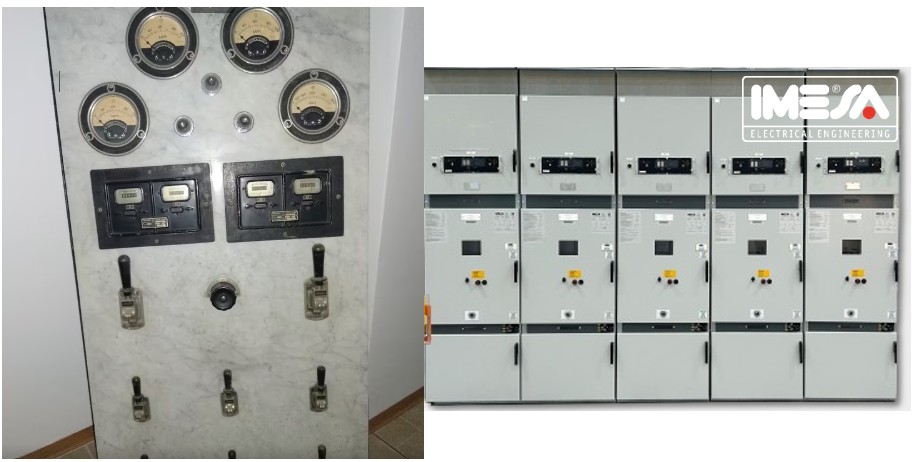

Sometimes the simplest questions are the ones that open the most interesting stories. One of these is: why are electrical panels called “quadri” in Italian?
For those who work in energy distribution, it’s a natural, almost obvious term. Yet its origin in Italian is very concrete: it comes from the shape… and it has stayed because it still perfectly describes the function.
Where the word “quadri” comes from
The word “quadri” (in English panel) comes from the Latin quadrum, linked to the idea of something square or rectangular. In Italian, however, “quadro” is not just a shape: it’s also an expression. When you “paint a picture of the situation,” you are organizing things, making something complex clear. And that is exactly what an electrical panel does: it organizes and makes energy within a system manageable.
Why electrical panels are called “quadri”: the historical origin
Between the late 1800s and early 1900s, when electricity began entering buildings and industrial systems, the first protection and switching devices were not housed in enclosed cabinets as we think of them today.
They were mounted on flat panels, often wall-mounted, typically rectangular. On them you would find components that now seem “vintage,” but were standard at the time:
- disconnectors (often knife switches),
- fuses,
- analog pointer instruments,
- visible wiring and connections.
Those were, quite literally, panels.
From panel to cabinet: what has changed (and what hasn’t)
During the 20th century, industry and electrical networks expanded, and everything changed: power levels increased, safety requirements grew, and the need for service continuity became critical. The “panel” evolved into enclosed metal structures—better protected and increasingly organized.
Today, a panel can be:
- LV (low voltage), for industrial and civil distribution,
- MV (medium voltage), for primary or secondary distribution and infrastructure,
- equipped with advanced protection logic, instrumentation, and (when needed) integration with control and supervision systems.
And yet, we still call it a “quadri,” because the term no longer describes only the shape—it describes the idea of a control and distribution hub.
From shape to function
Today’s “quadri” (panels) are no longer simply “rectangles”:
- they are modular systems,
- they integrate automation and communication,
- they interface with SCADA and EMS systems,
- they are designed for safety, service continuity, and sustainability.
And in the case of new dry-air solutions (without SF₆), they also represent a technological and environmental transition. But the name remains—because it tells the story of where we come from.
A word that tells the story of Italian industry
In English, people speak of:
- electrical panel
- switchboard
- switchgear
In Italian, instead, we simply say: quadro elettrico. A concrete, industrial, essential word. A term that originates from a geometric shape and becomes the heart of energy distribution.
The next time you enter an electrical room and see rows of aligned enclosures, remember that it all started from a rectangular panel fixed to a wall. A “quadro,” indeed.
If you are evaluating a new system or a revamping project, IMESA designs and manufactures MV/LV power panels and tailor-made solutions for various application contexts.
FAQ on electrical panels
Why is it called “electrical panel” and not “electrical cabinet”?
Because the term originated when devices were mounted on panels (thus “quadri”), and it remained even when the enclosure became a closed cabinet. Today, “panel” mainly refers to the distribution and control function.
Are “electrical panel” and “distribution board” the same thing?
Often yes, in everyday language. Technically, “distribution board” emphasizes the role of distributing energy to different lines/loads. In many industrial contexts, however, “electrical panel” remains the broader term that includes distribution, protection, and control.
What is the difference between LV and MV panels?
The difference lies in the voltage level, and therefore in components, requirements, and applications. LV is typical of final distribution in plants and facilities, while MV is used where upstream distribution and transformation (primary/secondary) must be managed.
What is the real purpose of an electrical panel in an industrial system?
It makes the system safe and manageable: protection, isolation, distribution, measurement, and control all pass through it. It is a central hub for service continuity and maintenance.