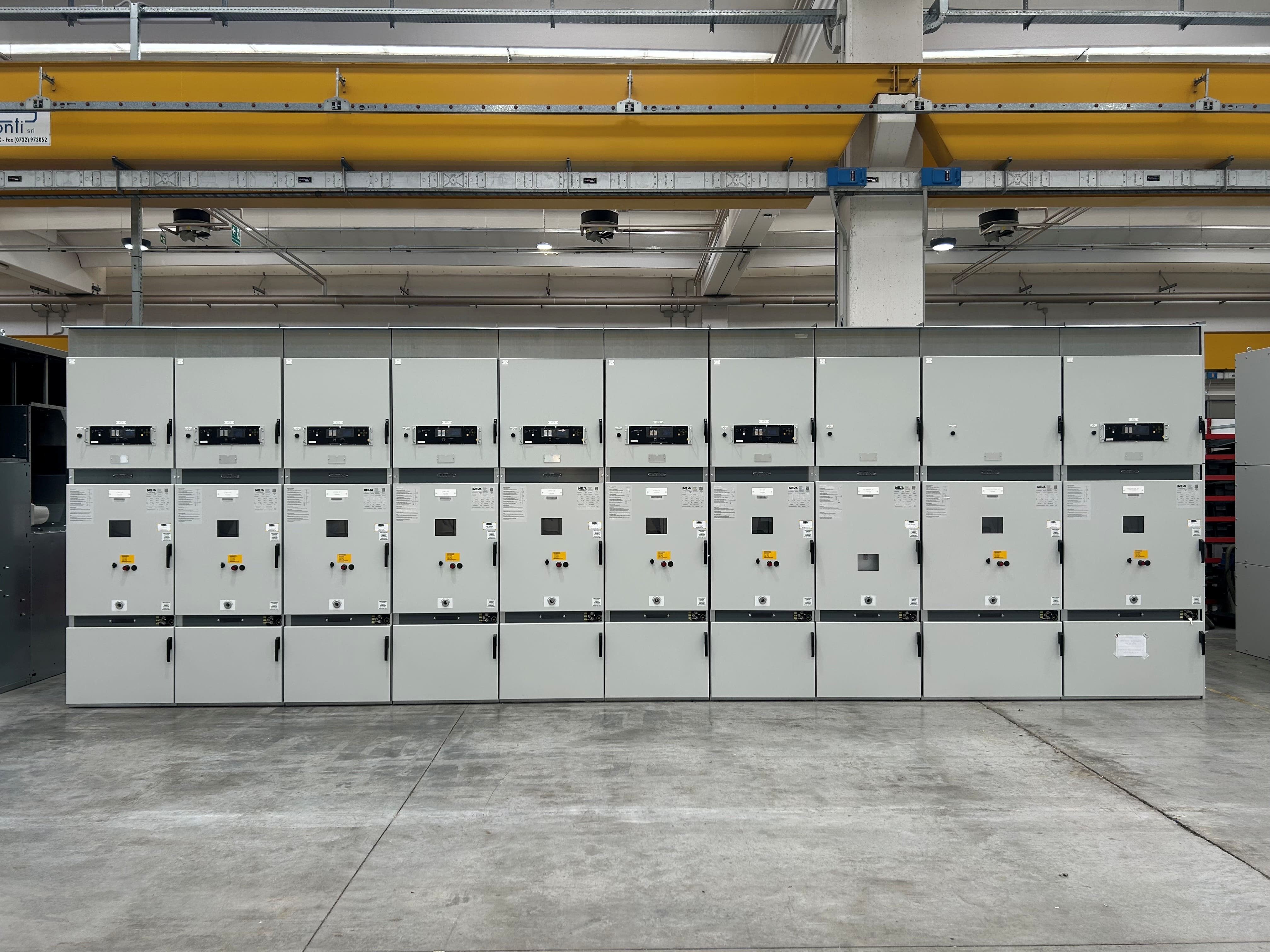

IMESA offers solutions for both electrical utilities and industrial applications.
The fundamental difference is that medium-voltage (MV) switchgear approved in accordance with the specifications of electrical utilities, such as e-distribuzione’s GSCM009 specification, is designed to meet the standardized requirements of the utility. Conventional industrial MV switchgear, on the other hand, is primarily designed around the specific needs of the facility it serves.
The difference is therefore not simply a matter of construction: it mainly concerns design requirements, permitted configurations, equipment, testing, and the qualification process.
Another important aspect to consider is the intended application.
Taking the GSCM009 specification mentioned above as an example, it defines the performance and construction characteristics of switchgear that is not intended for installation in secondary substations or industrial distribution substations.
In fact, this specification applies to MV switchgear panels intended for installation in e-distribuzione’s HV/MV primary substations. In the case of IMESA’s solution, the JesGear® 24 kV switchgear, this refers to an air-insulated switchgear (AIS) assembly featuring withdrawable circuit breakers, defined operating and safety sequences and logic, and designed for indoor installation.
Conversely, industrial switchgear is normally intended for internal power distribution within a facility, supplying transformers, motors, process lines, general distribution systems, and so on. Its configuration is defined by the designer according to the customer’s requirements. The switchgear must therefore provide greater configuration flexibility, with operating and safety sequences and logic determined by the characteristics of the industrial installation.
The key architectural features of switchgear compliant with GSCM009 include:
- Metal-enclosed compartments;
- Withdrawable circuit breakers mounted on trolleys;
- An earthing switch located in the cable compartment, at the rear;
- All operating procedures carried out from the front;
- Mechanical and electrical interlocks with key-operated locks;
- A dedicated compartment for releasing the overpressure generated by an internal arc.
What changes for the manufacturer?
From an industrial and commercial perspective, there are four key differences.
1. Standardized design
The starting point is not a completely unrestricted solution: the architecture and functional configurations specified by the standard must be followed. This limits the scope for customization.
2. Greater focus on technical qualification requirements
It is not enough to declare that the switchgear complies with IEC 62271-200. Compliance with the GSCM009 specification must also be demonstrated, together with the applicable configurations and test conditions.
3. Greater production standardization
The repeatability of configurations can support industrialization, procurement, and spare parts management. Conversely, changes outside the specified configurations may require technical assessments and more stringent management of the qualified configuration.
4. A different market
Switchgear compliant with GSCM009 is primarily intended for the primary substations of electrical distribution utilities. Industrial switchgear, on the other hand, is aimed at end users, EPC contractors, plant engineering companies, and industrial infrastructure manufacturers.
Want to know more? Contact us