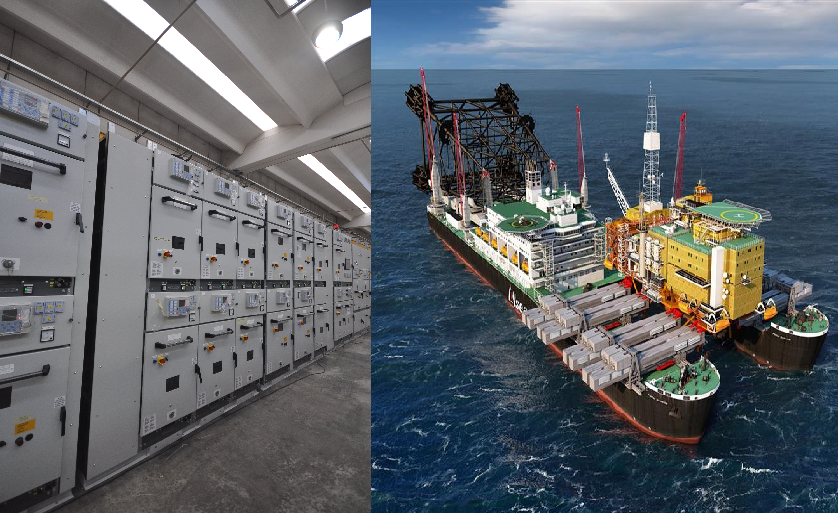

In offshore facilities and Oil & Gas platforms, electrical energy is not just a support to production, but the only defense system against isolation and environmental risk. When operating in the open sea, service continuity becomes the main obsession of every plant manager. A blackout in an onshore refinery is an economic problem; a blackout on a platform in the middle of the ocean is a safety emergency. For this reason, the design of IMESA electrical switchboards intended for these sectors is based on the assumption of maximum mechanical and electrical resilience.
Environmental resilience and protection against salt corrosion
The first enemy of service continuity is the environment itself. The marine atmosphere, rich in chlorides and constant humidity, is one of the most aggressive agents for copper and electronic components. At IMESA, we do not simply select robust enclosures; we apply painting treatments with C5-M cycles and use corrosion-resistant internal materials to ensure that the insulating properties of the switchboards remain unchanged for decades.
A small oxidation on a contact may seem like a detail, but in a critical system it can generate local overheating (a hot spot) capable of triggering a chain failure.
Protection selectivity and fault coordination
From an electrical point of view, ensuring continuous operation means implementing extremely refined protection selectivity. In an offshore system, the electrical network is often powered by gas turbines or local diesel generators that have a limited short-circuit capacity compared to the national grid.
Our Medium Voltage switchboards are equipped with digital protection relays that communicate in real time to isolate faults as close as possible to the load. If an extraction pump short-circuits, the system must ensure that the shore breaker or the main Power Center does not trip, keeping emergency systems, telecommunications, and safety installations (ESD – Emergency Shutdown Systems) powered.
Operator safety and internal arc resistance
In confined spaces such as offshore switchboard rooms, personnel safety is inseparable from service continuity. An internal fault that destroys the switchboard makes rapid power restoration impossible. For this reason, IMESA switchboards are certified for internal arc resistance.
In the event of a catastrophic failure, hot gases and overpressure are directed upwards or through dedicated exhaust ducts, preserving the integrity of adjacent panels and enabling partial system recovery in record time. This combination of physical robustness and intelligent distribution makes our solutions the standard for those who cannot afford even a second of downtime.
Internal arc resistance is therefore a key design requirement. The switchboard must be designed to contain the event and properly manage the release of hot gases and pressure, directing them to controlled zones and reducing risk for nearby personnel.
This aspect goes beyond immediate personal protection. A switchboard that limits the propagation of internal fault effects can preserve adjacent sections and, where possible, enable faster partial plant recovery. In other words, passive safety directly contributes to operational continuity.
In offshore applications, where downtime costs are high and operational impacts are significant, the ability to contain damage is an integral part of electrical infrastructure design quality.
Offshore electrical switchboards and long-term reliability
Service continuity is not only measured by fault response. It is also measured by the switchboard’s ability to maintain stable performance over time, reducing progressive component degradation and limiting the need for extraordinary maintenance.
In an offshore environment, long-term reliability depends on several factors: proper thermal dissipation, connection quality, humidity protection, mechanical strength of the enclosure, resistance to environmental cycles, and stability of electrical performance even under heavy or variable loads.
Every design choice affects the final outcome. A switchboard designed for standard environments and simply adapted to offshore conditions can hardly provide the same level of reliability as a solution conceived from the outset for harsh marine environments. For this reason, in Oil & Gas and offshore sectors, tailor-made design remains a decisive factor.
For IMESA, designing electrical switchboards for offshore applications means addressing service continuity, safety, and durability together. The goal is not only to distribute energy efficiently, but to build systems capable of supporting critical processes in environments where every technical detail has real operational consequences.
This requires expertise in enclosures for aggressive environments, protection coordination, internal arc design, and the selection of solutions that maintain reliability even under severe operating conditions.
In these contexts, switchboard quality is measured by its ability to remain stable over time, reduce downtime risk, and protect infrastructure when anomalies occur.
It is here that service continuity stops being a technical concept and becomes a concrete principle of electrical engineering design.