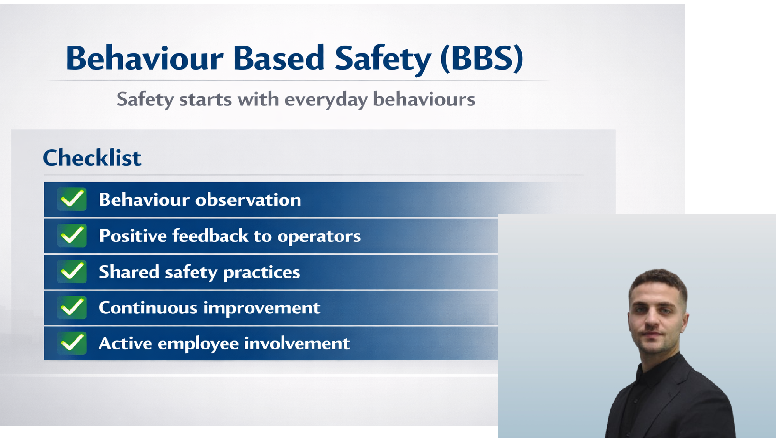

In recent years, Imesa has undertaken an important initiative to strengthen the safety culture within the company through the Behaviour Based Safety (BBS) project. Launched in 2024 and still evolving, the project has progressively involved an increasing number of employees, helping to raise awareness and understanding of safe behaviors in the workplace.
We spoke with Luca Anibaldi, recently appointed QHSE Manager, who, together with Cristiano Chiappa (Health and Facility Manager), has closely followed the development of the initiative.
Michela: Luca, let’s start from the beginning: what is the Behaviour Based Safety project and why was it introduced in the company?
Luca: The Behaviour Based Safety project was created with the goal of analyzing and improving people’s habitual behaviors while performing their daily work activities.
The basic idea is simple: observe daily activities across different departments to anticipate and prevent unsafe behaviors, which, as we know, can lead to accidents. We observe behaviors through checklists specifically designed for our production environment. We then provide positive and constructive feedback to the operators, aiming to reinforce good practices and promote greater safety awareness.
Michela: How was the project structured in its early stages?
Luca: At the beginning, in 2024, we selected a group of “Safety Leaders” made up of 10 people from different departments, with the purpose of analyzing our work activities and creating specific checklists for high-risk tasks.
This is where the project really begins. Safety Leaders start observing a colleague performing any activity during the day, filling out the relevant checklist. The observer then provides reinforcement feedback to the observed person. This is the key part of the project. Receiving external feedback allows the operator to become aware of incorrect habits and avoid repeating them.
I would like to point out that the person observed remains anonymous. It is not a question of controlling anyone but of preventing risky situations by ensuring the well-being of our employees.
A special feature of the project was the quarterly rotation of participants: every three months the observers changed. In this way, we were able to involve about 60 people during the year, expanding the dissemination of the culture of safety in the company.
Michela: What were the results of the first year of activity?
Luca: The results were very positive. In 2024, we have created over 450 observation checklists, a tool that has allowed us to collect concrete data on the behaviour adopted during work activities and to identify some areas for improvement in a timely manner. Thanks to this work of observation and direct comparison with operators, at the end of the year we recorded an increase in safe behavior of +12%, a significant result that demonstrates how much the active involvement of people can really affect daily safety.
In 2025, the project continued and was further strengthened. We have increased the number of observations and the commitment of the people involved, reaching about 760 checklists during the year. This more intense and structured work has led to a further improvement of +2% in safe behaviour, confirming the validity of the path taken and the progressive growth of the safety culture in the company.
At the same time, we have also observed a reduction in accident frequency indices, a very important signal because it shows that attention to behaviour, prevention and continuous discussion between colleagues can have a concrete impact on the work environment. In general, we can say that the project has contributed to making safety an increasingly shared and participated issue within the company.
Michela: In 2026 there is talk of BBS 2.0: what should we expect?
Luca: In 2026 we are working on an evolution of the project, which we can define as BBS 2.0, with the aim of consolidating what has been built so far and further improving the observation tools. We will continue to focus heavily on the involvement of people, because the active participation of employees is one of the elements that has made this path so effective.
Looking at the progress made so far, the balance is decidedly positive. Participation was large and this is probably the most significant result. Thanks to the work carried out together with Cristiano Chiappa and the contribution of many people in the company, we have seen the culture of safety grow in a concrete way in Imesa. The appreciation received for the project and the daily commitment of colleagues in making the work environment safer and safer are a great satisfaction for us.
Michela: In a company like ours, where activities are complex and varied, it becomes clear that safety does not come only from the rules, but from the daily behavior of each of us. It is the small gestures and good habits, shared every day, that really make the difference. Thank you Luca!